WSEO ProtocolThe open standard for Web3 visibility & on-chain reputation
Analyze DApps, smart contracts, NFTs and wallets. Get a verifiable score. Anchor it immutably on Polygon, BSC, or Avalanche. Earn your on-chain certificate.
Non-intrusive analysis Verified on-chain No signup required to analyze
Data Intelligence, Simplified
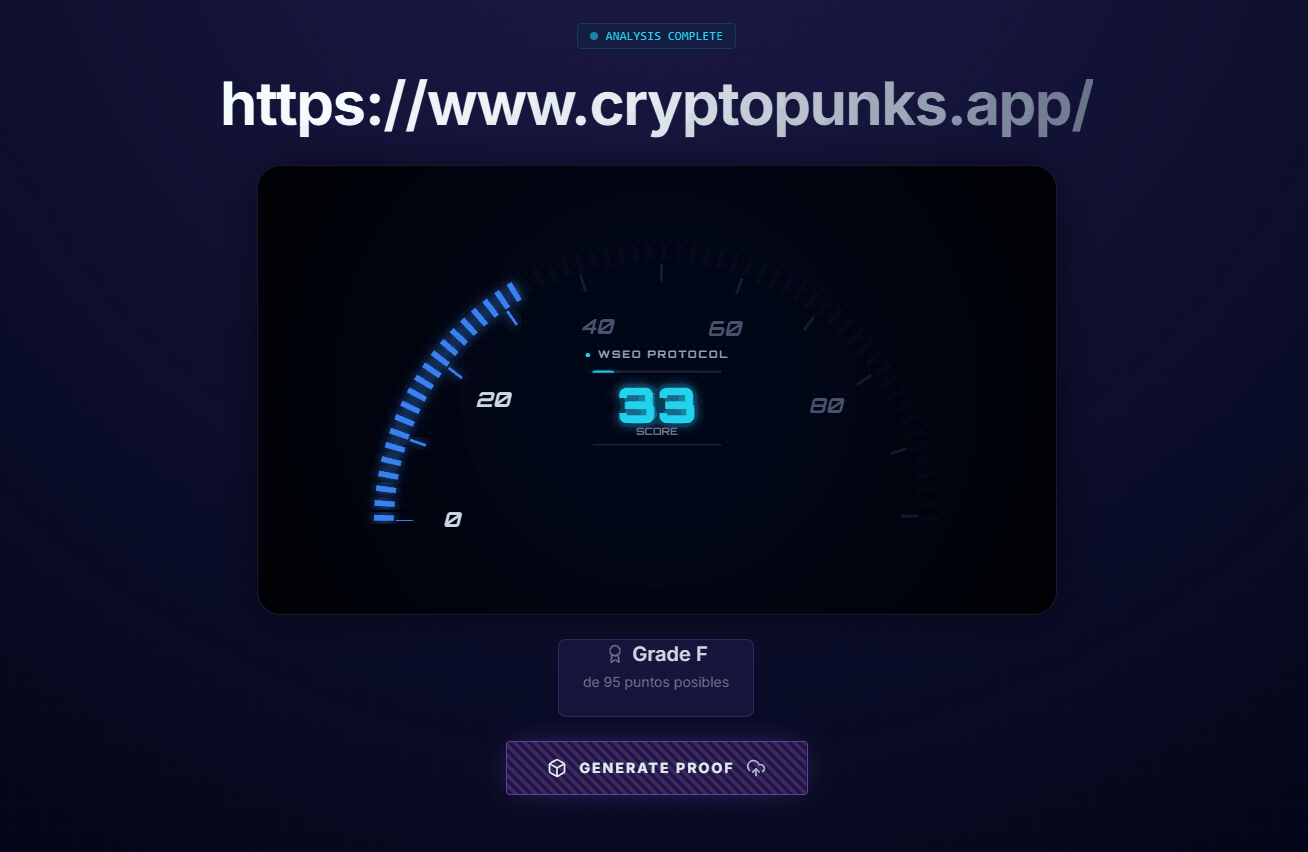
The WSEO Score unifies performance metrics, metadata security, and decentralization into a single auditable score.
Metadata & Decentralization
Detect faults in your contract indexing. We verify if your assets are truly safe on IPFS/Arweave or if they depend on vulnerable centralized servers.
Security & Trust
Analyses contract verification on explorers, transaction activity, and liquidity health to generate a proof of trust for your users.
Proof of Quality
Turn your audit into a cryptographic proof. Generate a verifiable badge that demonstrates to investors and users that your project meets the quality standard.
How It Works
Input
Enter your DApp URL, contract hash, or ENS domain.
AI Analysis
Our orchestrator scans off-chain metadata and on-chain executions in real-time.
Results
Get your WSEO Score, fix critical errors, and mint your quality certificate.
Multi-Layer Analysis
Our system analyzes both the traditional web layer and on-chain data
Web Layer (Off-Chain)
Metadata, speed, HTTPS, accessibility, content, and traditional SEO structure.
Blockchain Layer (On-Chain)
Contract verification, transactions, decentralized storage, and network activity.
Frequently Asked Questions
Everything you need to know about the WSEO Protocol
WSEO (Web3 Search Exposure Optimization) is an open protocol that measures, certifies, and improves the visibility and reputation of Web3 projects — DApps, smart contracts, NFTs, wallets, and ENS domains. It produces a verifiable score anchored on-chain.
Traditional SEO optimizes for search engines like Google, focusing on content and links. WSEO adds an on-chain trust layer that traditional tools cannot provide: immutable proof of security, decentralization, and contract quality, verifiable by anyone directly on the blockchain.
With WSEO you get: a verifiable score across 5 protocol dimensions (WSEP 1-5), an IPFS-stored audit report, an on-chain registered hash on Polygon/BSC/Avalanche, and — if you score 70+ — an SBT (Soulbound Token) certificate tied to your wallet. Investors and users can verify your quality independently.
Yes. Registered scores are stored in public smart contracts on Polygon, BSC, and Avalanche. Anyone can verify a registration directly on PolygonScan, BscScan, or Snowtrace. The report hash is also stored on IPFS — immutable and publicly accessible. The scoring model is in active development; scores are snapshots of the moment of analysis.
Analyzing is always free. On-chain registration requires a small gas fee (~0.001 MATIC) paid directly to the protocol's smart contract. This enables the on-chain anchoring of your score hash and SBT minting (for scores ≥ 70). The fee goes to the protocol — not to any third-party service.
WSEP (Web3 SEO Enhancement Proposals) are the five sub-specifications of the WSEO protocol: WSEP-1 Identity & Metadata, WSEP-2 Performance & Accessibility, WSEP-3 Security, Trust & QEP Layer, WSEP-4 Content & Authority, WSEP-5 Decentralization & Web3 Native. Each contributes a weighted portion to the final WSEO score.
Yes. QEPv4 is an iterative security roadmap, not a final endpoint. We improve it in stages: better cryptographic primitives, stricter verification flows, broader cross-chain echo checks, and continuous real-world hardening in production. It should be treated as a progressively stronger system, not as a definitive quantum-proof solution, until it can be tested and validated against real quantum computing environments.