The Dawn of Web3 SEO: Introducing the WSEO Protocol
The Definitive Guide to the First Standard for Web3 Visibility and Reputation

Executive Summary
The transition from Web2 to Web3 has revolutionized ownership, finance, and digital identity. Yet, the mechanisms for discovery, visibility, and trust remain stuck in the past or are entirely nonexistent. Google indexes text, but it does not understand Smart Contracts. It reads HTML, but it cannot verify if an NFT's metadata is compliant or if a DAO is transparent.
WSEO (Web3 Search Exposure Optimization) is the first protocol designed to bridge this gap. It is not just a tool; it is a standard, a protocol, and a reputation layer for the decentralized web.
This comprehensive guide explores the "Invisible Web3" problem, details the WSEO architecture, introduces the WSEP Standards, and explains how on-chain verification (SEOBeacon) is creating a new paradigm of trustless reputation.
Part 1: The Invisible Web3 (The Problem)
In the current landscape, the quality of a Web3 project is often judged by "hype" rather than verifiable metrics. This creates a dangerous environment for users and a frustrating one for legitimate builders.
1. The Metadata Chaos
In Web2, we have Schema.org and semantic HTML. In Web3, non-fungible tokens (NFTs) and dApps often rely on disparate, non-standardized JSON structures. A wallet or marketplace might display an asset correctly, while another shows a blank square. This fragmentation kills discoverability.
2. The Verification Gap
How do you know if a Smart Contract is safe? Users rely on expensive private audits, marketing, or follower counts. There is no programmatic, standardized way to query a contract's "health" or "reputation score."
3. The "Black Box" DAO
Decentralized Autonomous Organizations (DAOs) promise transparency, but their governance often happens in siloed forums or obscure Discord channels. Assessing the "activity" or "health" of a DAO requires manual investigation.
Part 2: The WSEO Protocol Solution
WSEO is an open protocol that introduces Search Exposure Optimization to Web3. It doesn't just rely on keywords but uses the transparency of blockchain technology to create a verifiable index of quality.
The Role of Visual Intelligence
Trust is hard to read in a raw transaction hash. That's why WSEO introduces the Galaxy Graph—a spatial visualization of your project's ecosystem.
By mapping relationships between wallets, contracts, and bridges in 3D, we can literally see the difference between a legitimate project (highly connected, organic clusters) and a rug-pull (isolated nodes).
New: Galaxy Graph Guide
Deep dive into how we visualize reputation across multiple chains (Ethereum, Polygon, Arbitrum).
Read the Visualization Guide →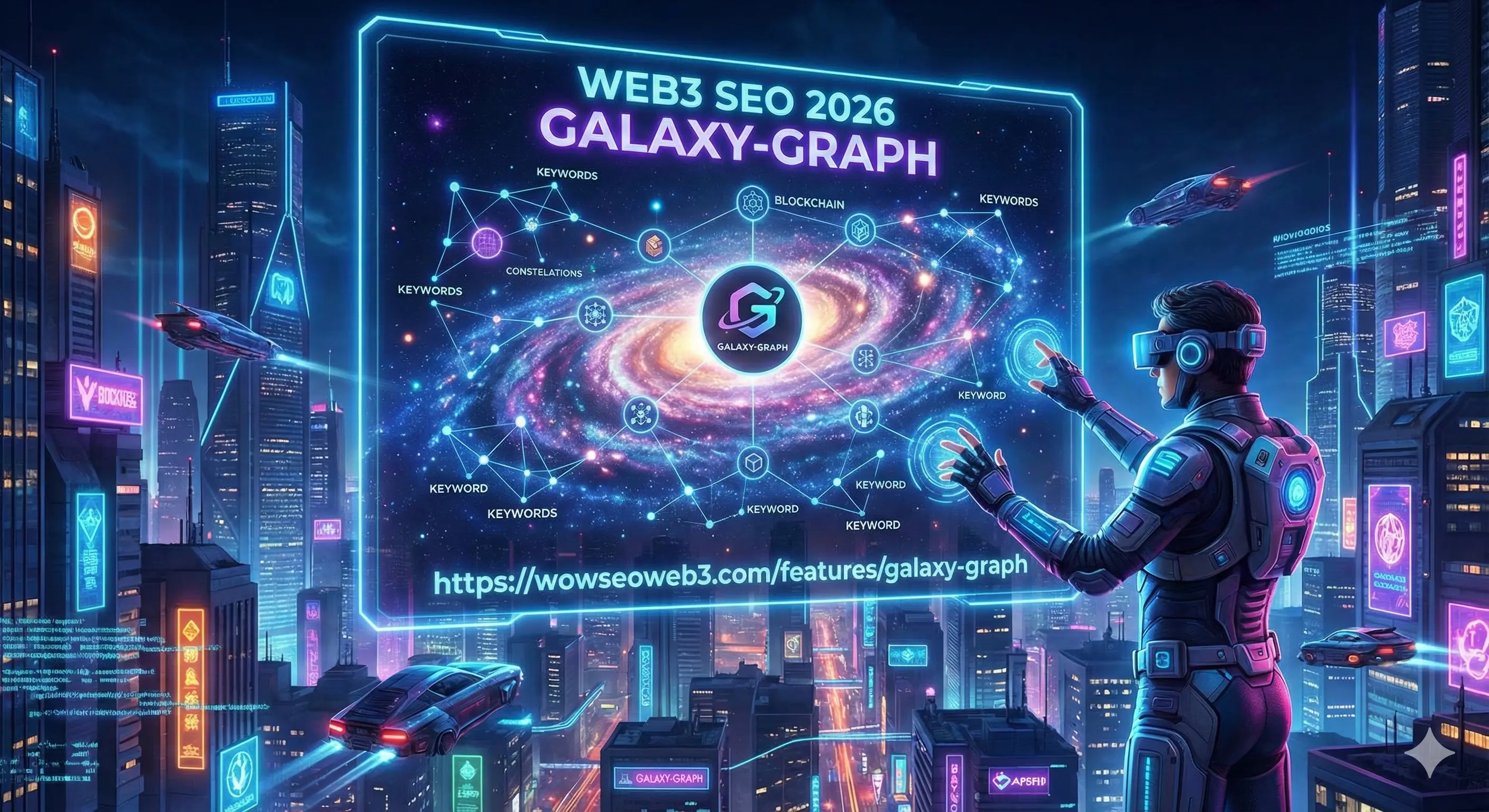
Check Your Web3 Visibility Score
Enter your URL or Contract Address to see if it meets WSEO standards.
Redirects to WSEO Tool for full analysis
The Three Pillars of WSEO
1. The WSEO Crawler (Cross-Chain Indexer)
Unlike a traditional Google bot, the WSEO Crawler scans blockchains (Polygon, Ethereum) and decentralized storage (IPFS, Arweave). It uses the Galaxy Graph to visualize cross-chain relationships and semantic AI to understand context.
2. WSEP Standards (Web3 SEO Protocol)
Just as HTTP and HTML defined the web, WSEO proposes the WSEP series of standards to guide development. Compliance with standards boosts a project's Score.
3. WSEO ReputationScore (On-Chain)
The output is a public, immutable Score (0-95) registered on the blockchain via the SEOBeacon contract. This score is portable and can be queried by any dApp using the WSEO Data Matrix.
Part 3: Deep Dive into WSEP Standards
The WSEP (Web3 Search Exposure Protocol) standards are the backbone of the WSEO scoring algorithm.
NFT Metadata Integrity
- Requirement: Strict adherence to ERC-721/ERC-1155 metadata standards.
- Media: High-availability IPFS gateways or permanent Arweave storage.
- Attributes: Standardized `trait_type` and `value` casing.
dApp User Experience & Security
- Wallet Connection: Graceful handling of wrong networks and errors.
- Core Web Vitals: Fast LCP, FID, and CLS scores.
- Security: CSP headers to prevent XSS attacks.
DAO Transparency (Draft)
- Governance: Publicly accessible proposal history.
- Treasury: Verifiable on-chain treasury addresses.
- Activity: Frequency of voting and proposal creation.
Smart Contract Assurance
- Verification: Source code MUST be verified on block explorers.
- Methodology: Presence of known security patterns (OpenZeppelin).
- History: Age of the contract and transaction consistency.
Part 4: The On-Chain Layer: SEOBeacon & SBTs
WSEO takes the unique step of moving "SEO" from a backend database to the blockchain.
The SEOBeacon Contract
Deployed on Polygon Mainnet (`0x1286D13b...`), the SEOBeacon is a smart contract that acts as a registry of truth.
- Immutability: Once a score is registered, a cryptographic hash (`SHA-256`) of the full report is stored on-chain. This prevents anyone from silently altering a report.
- Timestamping: It provides undeniable proof that "On Date X, Project Y had Score Z".
IPFS: Data Sovereignty
While the hash is on-chain, the detailed report (JSON) is stored on IPFS (InterPlanetary File System). This ensures that the documentation of a project's quality is decentralized and uncensorable, not hosted on a private AWS server.
Part 5: Use Cases & The Future
- For Developers (Audit-Lite): Use WSEO during development to catch metadata errors or security lapses before mainnet.
- For Founders (Trust Signal): Display your "Verified by WSEO" badge and SBT to attract users who are wary of scams.
- For Investors (Due Diligence): A low WSEO Score is a red flag for potential "rug pulls" or amateur dev work.
- Roadmap: Zero-Knowledge (ZK) proofs for private metrics and Cross-Chain Identity aggregation.
Conclusion: Join the Standard
The "Wild West" era of Web3 is maturing. Users demand safety, and legitimate projects deserve visibility. WSEO is not just a protocol; it is a movement towards a more transparent, standardized, and high-quality decentralized web.
Ready to see where you stand?
- Analyze your project at wowseoweb3.com/wseo.
- Optimize based on the WSEP feedback.
- Certify on-chain and mint your SBT.
Frequently Asked Questions
What is Web3 SEO?
Web3 SEO (Search Exposure Optimization) is the process of optimizing blockchain-based assets—such as Smart Contracts, dApps, and NFTs—to be discoverable and trustworthy within the decentralized ecosystem. Unlike Web2 SEO which targets Google, Web3 SEO targets wallets, block explorers, and decentralized search protocols.
Why do I need a WSEO Score?
Ideally, code should be law, but code is hard to read. A WSEO Score translates complex technical data (code verification, metadata compliance, security headers) into a single, verifiable number (0-95). This builds instant trust with users and investors who cannot audit code themselves.
How is the reputation verified?
Verification is on-chain. When you register a project, the WSEO Protocol generates a cryptographic hash (`SHA-256`) of your analysis report and anchors it to the Polygon ecosystem via the SEOBeacon smart contract. This makes your reputation immutable and censorship-resistant.
Rate this Article
Help us improve by rating the WSEO Protocol documentation.
4.9/5 based on community votesJoin the Web3 SEO Revolution
Subscribe to our official newsletter to receive the latest WSEP standards updates, case studies, and ranking tips directly to your inbox.
No spam. Unsubscribe at any time.

WowSeoWeb3
Web3 Security & Visibility Protocol
Pioneering the standard for decentralized reputation. We help projects verify their integrity and potential investors verified due diligence.